

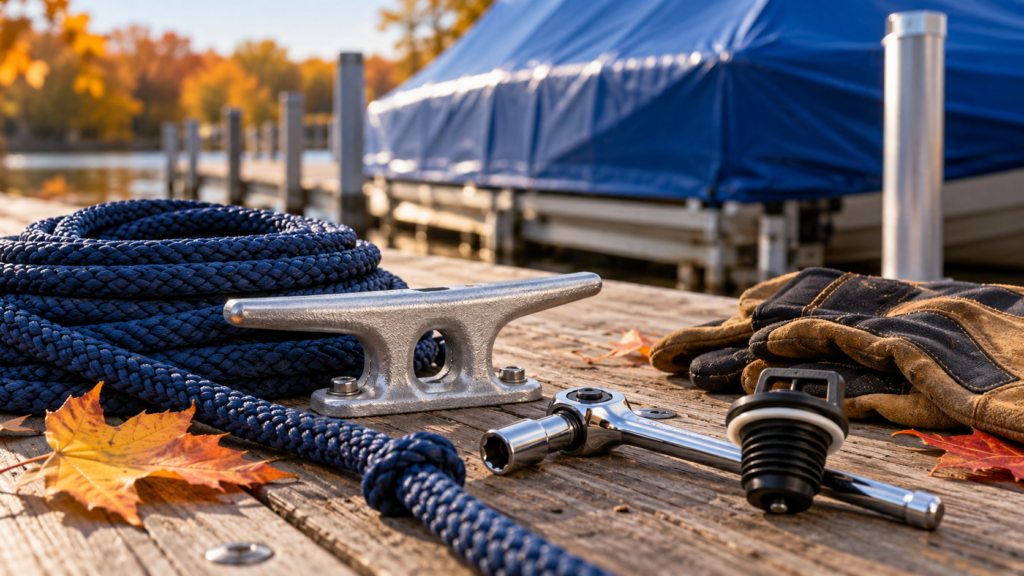
The pontoons are thinning out, the water has a bite to it, and the dock crews are already making their rounds. Fall on Lake Minnetonka means one last stretch of boating, followed by the chore every lake owner knows is coming: winterizing your dock and boat before the ice sets in. Get it right and spring is a simple reinstall. Put it off and you risk bent dock frames, cracked engine blocks, and a long wait for a storage spot.
This guide to winterizing your dock and boat walks through what to handle, in roughly the order you’ll handle it, so nothing slips through the cracks this season.
Start with the calendar, not the toolbox
The single biggest mistake is waiting too long to book. On Lake Minnetonka, fall dock removal generally runs from early September through mid-November, and the best dates go to people who got on the schedule early. Boat storage works the same way. Marinas and storage yards have a finite number of spots and a finite number of weeks to haul, winterize, and wrap everyone’s boats.
Water levels matter too. The Lake Minnetonka Conservation District notes that when water levels or temperatures run unusually low, dock companies may need to pull docks earlier so their equipment can still reach your shoreline, and storage companies may ask for boats sooner. If you added a temporary dock extension under a low-water permit, the LMCD requires it to be removed by November 15.
Book these first
- Dock and lift removal date
- Boat haul-out and winter storage spot
- Professional winterization service, if you’re not doing it yourself
- Spring reinstall date (many companies let you lock this in now)
Why the dock has to come out
Lake Minnetonka ice commonly reaches a foot and a half to two feet thick in a normal winter, and as it expands and shifts it pushes on anything left in the water with tremendous force. Posts get bent, frames get twisted, and sections can be lifted right off the lake bottom. That’s why seasonal docks around the lake are pulled every fall as standard practice. Unless your dock is specifically designed and permitted to stay in, plan on removal.
Dock and lift checklist
Whether a crew is doing the work or you are, walk the dock before it comes out. It’s much easier to spot problems while everything is still assembled.
- Inspect and note repairs. Look for loose or cracked decking, rusted hardware, bent legs, worn wheels, and damaged bumpers. Fixing them over the winter beats scrambling in April.
- Photograph your layout. Take pictures and measurements of the dock’s position, section order, and lift placement so the spring reinstall matches.
- Pull the canopy covers. Lift canopies catch wind and snow load. Remove them, let them dry fully, and store them indoors.
- Check the lift. Inspect cables, pulleys, and winches for fraying or corrosion before the lift is removed or stored.
- Shut down electrical and plumbing. Turn off and disconnect shore power, outlets, and lights at the water, and drain any water lines that run to the dock.
- Deal with buoys. LMCD code requires buoys on the lake to be removed or submerged beneath the ice so they don’t become a hazard.
- Store sections well up on shore. Stack dock sections and park lifts far enough from the water that spring ice and high water can’t reach them.
One more rule worth knowing: if you’re moving a dock or lift from another lake onto Lake Minnetonka (or vice versa), the LMCD requires it to dry out for 21 days first to help prevent the spread of aquatic invasive species.
Pick your boat storage
Before you winterize the boat, decide where it’s spending the next five months. Each option has trade-offs:
- Heated indoor storage offers the most protection and makes spring prep easiest, but it’s the priciest and fills up first.
- Cold indoor storage keeps the boat out of the snow and sun at a lower cost. Proper winterization is still essential.
- Outdoor storage with shrink wrap is the budget choice. A tight, well-vented wrap keeps snow and moisture out.
- Your own garage or property works for smaller boats if you have the space and the trailer, and gives you access to tinker over the winter.
Many marinas around the lake bundle haul-out, winterization, storage, and spring launch into one package, which can be the simplest route if you’d rather hand off the whole job.
Boat winterization checklist
Minnesota winters are unforgiving to any water left inside a boat. If you’re doing it yourself, follow your engine manufacturer’s procedure. If you’re unsure, especially with inboards, sterndrives, or anything with a closed cooling system, this is worth paying a pro for.
- Stabilize the fuel. Add fuel stabilizer, run the engine long enough to circulate it, and follow your manufacturer’s guidance on tank level.
- Change the oil and filter. Used oil contains acids and moisture that can corrode engine parts over a long layup.
- Protect the cooling system. Drain the engine block and manifolds or run marine antifreeze through the system. Trapped water that freezes can crack the block.
- Fog the engine. Fogging oil coats internal parts to prevent rust during storage.
- Empty the ballast. Wake surf and ski boats need every ballast tank and bag fully drained. Frozen ballast can split tanks and ruin pumps.
- Drain everything else. Freshwater systems, livewells, baitwells, sinks, showers, and heads all need to be emptied or treated with non-toxic antifreeze.
- Handle the battery. Remove it or disconnect it, charge it fully, and keep it on a maintenance charger.
- Clean and dry the interior. Pull out cushions, life jackets, electronics, and valuables. Leave compartments cracked open to discourage mildew.
- Cover it properly. Use a fitted cover or professional shrink wrap with vents so moisture can escape.
Don’t forget the invasive species rules
Lake Minnetonka has been fighting zebra mussels and other invasive species for years, and haul-out is one of the easiest times to accidentally move them. Minnesota law requires boaters to clean off aquatic plants and animals, drain all water, and pull the drain plug before leaving any public access, and to keep that plug out while trailering. The Minnesota DNR has full details on the requirements.
Looking ahead to ice season
Once the docks are out and the boats are wrapped, the lake shifts into its winter personality: ice fishing, skating, and the occasional ice road. The LMCD publishes a set of winter rules and resources covering public access points, ice house deadlines, and safety, and we’ll be covering ice season in depth here in December.
Until then, get your dates booked, work through this list for winterizing your dock and boat, and enjoy the quiet side of the lake. If you’re looking for a dock company, marina, or storage provider, browse our Trusted Partners directory, check out our Boating page for marinas around the lake, and if the leaves are still hanging on, catch our guide to the best spots to see fall colors around Lake Minnetonka before they’re gone.