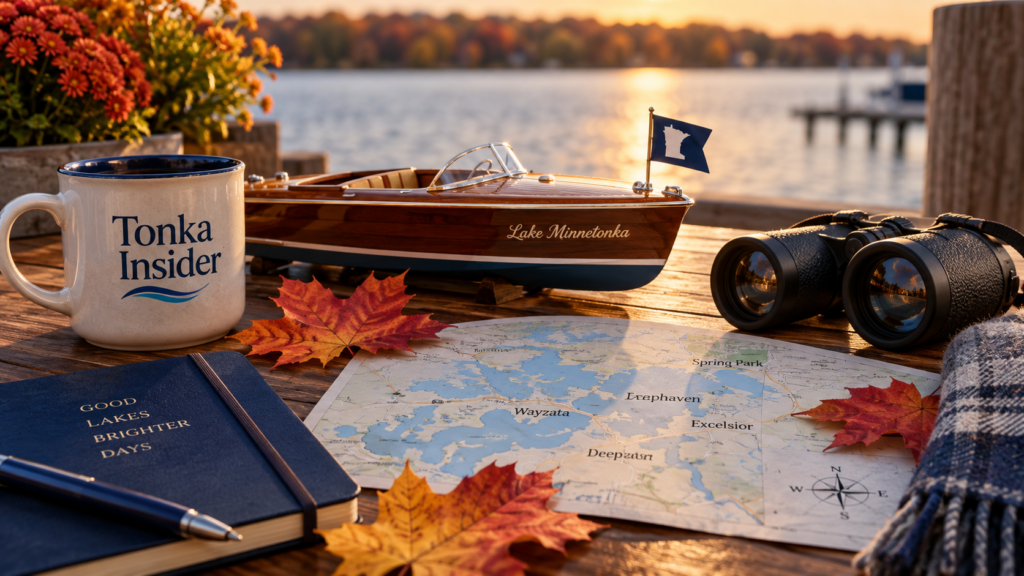

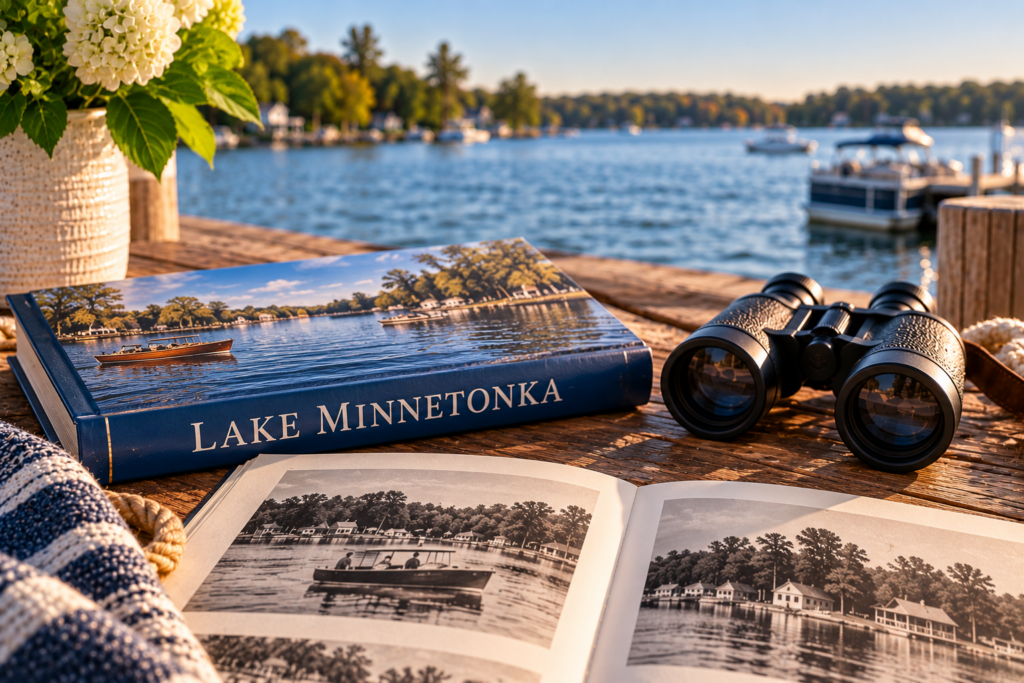
Every bay on Lake Minnetonka has a name, and nearly every name has a story behind it. Some honor homesteaders who arrived in the 1850s with little more than a land claim. Some remember grand hotels that burned more than a century ago. One recalls a town that never got off the ground. A few simply describe what early settlers saw when they looked at the water.
Before any of these names, the lake itself already had one. Minnetonka comes from the Dakota name for the lake, used for generations before Territorial Governor Alexander Ramsey’s party adopted it in 1852. The bay names came after, as settlers moved in and, more often than not, named the shoreline after themselves.
So how many bays are there?
It depends on who’s counting. Wikipedia puts it at about 23 named bays and areas. The Minnehaha Creek Watershed District has monitored anywhere from 20 to 27 separate bays in different years. One detailed shoreline guide splits the lake into 37 by counting every connected basin. This guide covers the bays whose name origins are documented in the historical record.
First, a map puzzle: why is the Lower Lake on top?
Look at any map of Lake Minnetonka and the “Lower Lake” sits to the north and east, above the “Upper Lake.” That’s because the names follow the water, not the map. Most of the lake’s water enters through Six Mile Creek in Halsted’s Bay, in the Upper Lake to the west. It leaves through Gray’s Bay, in the Lower Lake to the east, where it spills into Minnehaha Creek. Upstream is upper, downstream is lower.
The two halves meet at the Narrows, in Lafayette Bay. It was once a small creek. Reverend Stephen Hull, who farmed the land beside it, agreed to let it be dredged and widened in 1873 so steamboats could pass, which is why it’s also known as Hull’s Narrows.
Bays named for the people who settled them
Most of the lake’s bays carry the last name of an early landowner. These are the families who cleared the land, built the first cabins, and in several cases moved on within a few years.
Gray’s Bay
Earlier names: Lake Browning, Outlet Lake
The lake’s only outlet is named for Amos Gray, one of the original settlers of the Wayzata area in 1853. Before that, the writer Elizabeth Fries Ellet had dubbed it Lake Browning in 1852, after the English poet Robert Browning. Into the 1890s some people still called it Outlet Lake, since this is where Minnetonka empties into Minnehaha Creek.
Robinson’s Bay
Alfred B. Robinson worked at Fort Snelling in the 1840s before settling on this bay in 1853. He went on to serve as one of Wayzata’s original justices of the peace.
Carson’s Bay
Earlier name: Pig’s Inlet
Few bays got a bigger upgrade. Until the 1870s this sheltered bay was known as Pig’s Inlet. It was renamed for Elijah Carson, a Maine native who came to Excelsior in 1855 and became a prominent member of the early community.
Gideon’s Bay
Peter Gideon settled above this bay’s western shore in 1853 and became one of Minnesota’s most important fruit growers. He bred an apple that could survive Minnesota winters and named it the Wealthy, after his wife. A 1912 plaque honoring his work still stands near Gideon Lane and Glen Road in Tonka Bay.
Carman’s Bay
John Carman claimed roughly 14,000 acres of land and water in the Upper Lake region in 1853. His first home was a two-room log cabin on Shady Island. After about a year, the family sold it and moved to the peninsula now called Casco Point.
Cook’s Bay
Mathias Cook, John Carman’s son-in-law, built one of the first year-round homes in the Upper Lake region here in 1854, a small log house. In 1868 he opened the three-story Lake View Hotel overlooking the bay that carries his name.
Priest’s Bay
J.D. Priest owned a farm on this bay’s north shore. In 1880 a channel was dredged and widened here so boats could reach the lake’s westernmost bay, Halsted’s.
Halsted’s Bay
Frank W. Halsted settled here in 1855, well ahead of most other settlers in the far western reaches of the lake, and built a small home he called The Hermitage. He died on the lake in 1876. His brother George kept The Hermitage until it burned in 1901, a fire that also took George’s life. Today Halsted’s Bay is where Six Mile Creek, the lake’s main source, flows in.
Phelps Bay
Carrington Phelps bought the large neighboring landmass in 1875, and both Phelps Island and Phelps Bay to its south carry his name. The island started out as a peninsula. Channels dredged in the 1880s at Cook’s Bay and Spring Park Bay effectively turned it into an island.
Smithtown Bay and Smith’s Bay
Two bays, one family. Brothers Elliot and William Smith owned land on Smithtown Bay in the 1850s and planned to build a town there. They put up a mill and two log houses and widened an existing Native American trail into what became Smithtown Road, but settlers chose Excelsior instead and Smithtown never happened. Across the lake, Smith’s Bay is named for the same brothers. Elliot’s farm sat on its north shore until James J. Hill bought it in 1880 to bring his railroad through to the Lafayette hotel.
Harrison’s Bay
Nathaniel Harrison, a Virginia-born carpenter and shipbuilder, homesteaded here in 1855 and stayed 11 years. He helped build some of the best-known boats of the lake’s early days, including the steamers May Queen and Mary.
Jennings Bay
Frederick A. Jennings was an English-born printer working in New York when he read newspaper ads promoting Lake Minnetonka as the last frontier. He bought land on the west side of this bay in 1855 and moved here for good in 1857.
Maxwell Bay
John Maxwell settled the bay’s northeast shore in 1854.
Stubbs Bay
Earlier names: Teas Bay, Bean Bay
The lake’s northernmost bay went through two names before landing on Stubbs, for Joel Stubbs and his large family. The Stubbses owned a great deal of property around the lake and, like Peter Gideon on the south shore, were deeply involved in growing fruit.
Brown’s Bay
Brown’s Bay is named for Joseph R. Brown, one of the best-known figures of Minnesota’s territorial era. Local histories credit a teenage Joseph Brown from Fort Snelling with one of the first documented Euro-American trips to the lake, paddling up the creek in 1822 with a group of Mdewakanton Dakota men who knew the way.
Bays named for hotels and towns
By the 1880s Lake Minnetonka was one of the Midwest’s great resort destinations, and a few bays took their names from the hotels and towns of that era. Some of those places are long gone. The names stayed.
St. Louis Bay
Charles Gibson, a wealthy St. Louis lawyer, built the Hotel St. Louis overlooking this bay. It was one of the lake’s first resort-style hotels and hosted the Northwestern Lawn Tennis Championships. Gibson also had the bay dredged, and the fill created two islands: Lighthouse Island, which despite the name never had a lighthouse, and the smaller Bug Island. Gibson and other prominent lake residents founded the Minnetonka Yacht Club here in 1882.
Lafayette Bay
Earlier name: Holmes Bay
Railroad baron James J. Hill opened the Lafayette hotel on the bay’s north shore in 1882. It burned in 1897, and the site later became home to the Lafayette Club. The bay also holds the Narrows, the channel between the Upper and Lower Lakes.
St. Albans Bay
This bay is named for the village of St. Albans, which once stood on its eastern shore. The village had failed by 1859. The bay kept the name anyway.
Excelsior Bay
Named for the town that wraps around its southern shore.
Spring Park Bay
Earlier name: Byers Bay
Originally named for an early landowner, the bay later took the name of the city that surrounds it. The city, in turn, is named for a natural spring on Casco Point.
Wayzata Bay
Earlier name: Lake Bryant
Wayzata Bay was once called Lake Bryant, after the poet William Cullen Bryant. It later took the name Wayzata, an anglicized Dakota word associated with the north.
Bays named for what was there
A handful of names are simply descriptions, and they still fit.
Crystal Bay is named for its deep, clear water. Emerald Lake got its name from the green fringe of reeds and lilies along its shore, and Black Lake from its dark, shaded water. Seton Lake is the exception in this group: it’s named for the Seton Guild, an all-girls Catholic school that once sat on its shore. Together Emerald, Seton, and Black form a back-channel route from Halsted’s Bay toward Harrison’s Bay.
Bays named for where they sit
The most straightforward names on the lake belong to the West Arm and the North Arm, named for exactly where they are. The North Arm connects to Crystal Bay through a channel on Crystal Bay’s northwest shore.
A lake full of names that changed
If there’s one lesson in all of this, it’s that Lake Minnetonka’s names were never fixed. Settlers disputed them, land changed hands, and places were renamed after new owners, hotels, poets, and hometowns. Big Island alone has been Meeker’s Island and Morse’s Island. The names on today’s maps are simply the ones that stuck.
Next time you’re out on the water, or crossing the Narrows bridge, you’ll know a little more about who came before.
Sources: Josh Biber, “The History of Lake Minnetonka’s Bays, Points, and Islands,” The Minnesota Historian (2023), which draws on Warren Upham’s Minnesota Geographic Names (Minnesota Historical Society, 1920) and Thelma Jones’s Once Upon a Lake (1969); Wikipedia, “Lake Minnetonka”; Minnehaha Creek Watershed District monitoring reports.